ETFs and index funds for beginners
An index fund copies a market index, such as the S&P 500 or the MSCI World, by holding the same companies. An ETF (exchange-traded fund) is a fund you buy and sell on a stock exchange, like a single share. With either one, a single purchase gets you hundreds of companies, usually at a low cost.
What an index is
An index is a scoreboard for a group of shares. When the news says "the market rose 1% today", it is quoting an index. Some of the most followed:
| Index | What it tracks |
|---|---|
| S&P 500 | 500 large US companies |
| Nasdaq-100 | 100 large non-financial companies on the Nasdaq exchange, heavy in technology |
| MSCI World | Roughly 1,300 to 1,400 large and mid-sized companies across 23 developed countries |
| MSCI Emerging Markets | Large and mid-sized companies in about 24 emerging economies |
| FTSE 100 | The 100 largest companies on the London Stock Exchange |
| Euro Stoxx 50 | 50 large companies from eurozone countries |
| IBEX 35 | The 35 most traded companies on the Spanish stock exchange |
| Nifty 50 | 50 large companies on the National Stock Exchange of India |
| IDX Composite (IHSG) | Almost every share listed on the Indonesia Stock Exchange |
| S&P/BMV IPC | The main index of the Mexican Stock Exchange (BMV) |
| Nikkei 225 | 225 large Japanese companies |
Index fund vs ETF vs active fund
| Index mutual fund | ETF | Active fund | |
|---|---|---|---|
| Goal | Copy an index | Usually copies an index | Beat the market |
| How you buy | Through a fund platform or app | On a stock exchange, through a broker | Through a fund platform or app |
| Price | Once a day | Live, during market hours | Once a day |
| Fees | Usually low | Usually low | Usually higher |
Most ETFs follow an index, but not all of them. Some are actively managed, and some use borrowed money or bet on falling prices. Read the fund's name and its key information document before you buy.
Why beginners use index funds
- Diversification: one purchase spreads your money across many companies, so a single failure cannot sink you.
- No stock picking: you own the market instead of guessing winners.
- Low cost: copying an index is cheaper than paying a team to pick shares, and you keep the difference every year.
- Easy to follow: the index rules are public, so you always know what the fund holds and why.
Index vs active funds: what the data shows
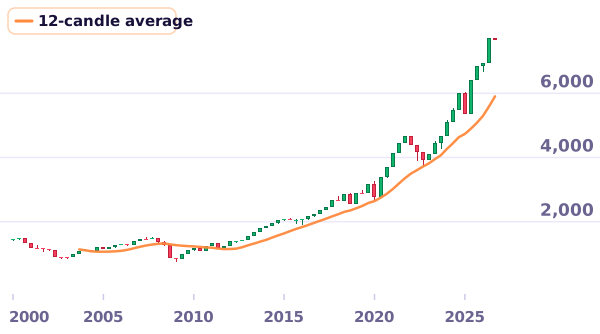
Active funds pay managers to pick shares and try to beat an index. Since 2002, S&P (today S&P Dow Jones Indices) has published SPIVA reports that compare active funds with their benchmark. The results barely change from report to report: in most single years, more than half of US large-company funds trail the S&P 500, and over 15 years close to 9 in 10 do.
SPIVA reports for Europe, India, Latin America and other regions show the same pattern over long periods, although the exact share varies by market and year. The main reason is cost. A fund that charges 1% a year has to beat the market by 1% just to match a cheap index fund. Some active managers do beat the index, but it is hard to know in advance which ones.
What ETFs cost: TER and other fees
Every fund charges a yearly fee called the total expense ratio (TER) or ongoing charge. It is a percentage of your money, taken from the fund, so you never see a bill. On every $10,000 invested, a TER of 0.07% costs $7 a year, 0.20% costs $20 and 1% costs $100. Broad index ETFs on the S&P 500 or the MSCI World often charge less than 0.2% a year.
That looks tiny, but it compounds. Here is $10,000 growing at 6% a year before fees, for 30 years:
| Yearly fee | After 30 years | Cost of the fee |
|---|---|---|
| No fee | $57,435 | |
| 0.1% a year (typical index ETF) | $55,831 | −$1,604 |
| 0.5% a year | $49,840 | −$7,595 |
| 1% a year (typical active fund) | $43,219 | −$14,216 |
Also check trading commissions, the ETF's spread (the gap between the buy and sell price) and currency conversion fees if you buy a fund in another currency. Then look at the tracking difference: how far the fund's return was from its index over a year. A good index fund trails its index by little more than its fee.
Risks to know
- Market falls. An index fund falls with its market. The S&P 500 lost more than half its value between 2007 and 2009 and took more than five years to get back to its old high.
- Concentration. Big indexes are weighted by company size. In 2025, the ten largest companies made up more than a third of the S&P 500, and about 70% of the MSCI World was in US companies.
- Currency risk. If you live in Indonesia, Mexico or India and buy a fund priced in US dollars, a stronger rupiah, peso or rupee lowers your return in local money, and a weaker one raises it.
- Complex products. Leveraged and inverse ETFs reset every day and can lose value even when the index ends flat. Thematic and crypto ETFs are far less diversified than a broad index.
- Owning vs betting. A CFD on an ETF is a leveraged bet on its price, not a share of the fund. Most retail CFD accounts lose money.
How to get started
- Build an emergency fund first.
- Choose a broker or fund platform licensed by your own country's regulator.
- Pick a broad index you understand, such as a global or total-market fund.
- Invest a fixed amount every month (dollar-cost averaging).
- Hold for years, and don't panic-sell in a crash.
Where you live shapes what you can buy. In the EU, everyday investors usually buy UCITS ETFs, often based in Ireland or Luxembourg, because most US-listed ETFs don't publish the key information document that EU rules require. In India, index funds and ETFs on the Nifty 50 and the Sensex are regulated by SEBI. In Indonesia, ETFs listed on the IDX and index mutual funds (reksa dana indeks) are supervised by OJK. In Mexico, many foreign ETFs can be bought in pesos through the Sistema Internacional de Cotizaciones (SIC).
FAQ
What is the difference between an ETF and an index fund?
Both usually copy an index. An ETF trades on a stock exchange like a share, with a live price during market hours. An index mutual fund is bought through a fund platform at one price per day.
What is a TER?
The total expense ratio is the yearly cost of running a fund, shown as a percentage. A TER of 0.2% costs $20 a year for every $10,000 invested. It is taken from the fund, so you never see a bill.
Do index funds beat active funds?
Not every year, but over long periods most active funds fall behind. S&P's SPIVA reports have found that close to 9 in 10 US large-company funds trailed the S&P 500 over 15 years, mainly because of their higher fees.
Are index funds safe?
They spread risk across many companies, but they still fall when the whole market falls, sometimes by half. They suit long-term goals, not money you will need in the next few years.
What is the MSCI World index?
An index of roughly 1,300 to 1,400 large and mid-sized companies across 23 developed countries. About 70% of it was in US companies in 2025, so it is less global than the name suggests.
How much do I need to start?
Many platforms offer fractional shares or monthly plans that start with small amounts. Check the fees first: a fixed fee per trade hurts small amounts the most.
Sources: S&P Dow Jones Indices (SPIVA scorecards), MSCI index factsheets, Robert Shiller's S&P 500 data (monthly averages to September 2026), ESMA. Educational content, not financial advice.

Can you beat the index?
Pick 5 stocks, then race a monkey and the whole index over 5 years.
Play Monkey vs ManagerKeep reading
 Gold price history: yearly averages since 2000 and what moves goldGold averaged $279 an ounce in 2000 and $3,442 in 2025, then passed $5,000 in 2026. See every year, the 2024 to 2026 rally, and what moves the gold price.Read the guide
 How to choose a safe, regulated brokerHow to check a broker's licence with the FCA, ASIC, CySEC, SEBI, OJK or another regulator, which protections cover your money, and the red flags of scams.Read the guide
 What is inflation? How it is measured and what it does to your moneyInflation for beginners: how the CPI basket works, central bank targets, why prices jumped in 2022, real returns and what inflation does to savings.Read the guide