What is inflation? How it is measured and what it does to your money
Inflation is the pace at which prices rise across an economy. At 3% a year, something that costs 100 today costs about 103 next year. That sounds small, but it adds up: after 25 years at 3%, cash buys less than half of what it used to.
What inflation is
Inflation means the same money buys less over time. A coffee, a bus ticket or a month of rent slowly costs more, so every banknote in your wallet is worth a little less each year. Central banks aim for a small, steady rise. It keeps people spending and investing without eating savings too fast.
The opposite, prices falling across the whole economy, is called deflation. It sounds pleasant, but it usually comes with weak demand and job losses. Japan struggled with it for years after the 1990s. At the other extreme, hyperinflation destroys a currency in months, as Zimbabwe saw in 2008 and Venezuela in 2018.
How inflation is measured
Every month, statisticians record the prices of a typical household shopping basket: food, rent, transport, energy, health, education, phone bills and more. Each item gets a weight that reflects how much households really spend on it. In the US basket, housing is about a third of the total. In India and Indonesia, food takes a much bigger share than in the US or the UK.
Here is how the weights work. Take a simple basket where food is 40% of spending, rent 40% and transport 20%. Food prices rise 10%, rent rises 5% and bus fares fall 5%. Food adds 4 points (40% of 10%), rent adds 2 points (40% of 5%) and transport takes away 1 point (20% of 5%). Inflation is 5%.
The price of the whole basket is the consumer price index (CPI). Its change over 12 months is the inflation rate you see in the news. Most countries publish it once a month, and traders compare each release with economists' forecasts.

Headline or core? Headline inflation includes everything. Core inflation leaves out food and energy, whose prices jump with the weather and with wars. Central banks watch core inflation to see the underlying trend.
What inflation rate is normal?
Most central banks publish an inflation target. In rich economies it is usually 2% a year. Many emerging economies aim a little higher, often with a band around the target, because their prices tend to move more.
| Central bank | Inflation target | Details |
|---|---|---|
| US Federal Reserve | 2% | Measured with the PCE price index |
| European Central Bank | 2% | Euro area, over the medium term |
| Bank of England | 2% | UK consumer price index |
| Bank of Japan | 2% | Japan consumer price index |
| Bank Indonesia | 2.5% | Plus or minus 1 percentage point |
| Banxico (Mexico) | 3% | Plus or minus 1 percentage point |
| Reserve Bank of India | 4% | Plus or minus 2 percentage points |
What causes inflation
- Energy shocks. Oil and gas feed into transport, factories and food, so a price spike spreads everywhere. The 1973 oil embargo roughly quadrupled oil prices.
- Supply problems. When factories close or ships get stuck, fewer goods meet the same demand, and prices rise.
- Strong demand. When people and governments spend faster than the economy can produce, shops can raise prices without losing customers.
- Too much money. When money grows much faster than the goods it can buy, prices climb. Printing money to pay the bills is how hyperinflation starts.
- A weaker currency. When a currency falls, imports cost more in local money, and shops pass those costs on.
- Expectations. If everyone expects prices to keep rising, workers ask for bigger pay rises and shops raise prices in advance. Inflation can feed itself.
The 2022 inflation wave
After the pandemic, demand came back faster than supply. Then Russia's invasion of Ukraine pushed energy and food prices up sharply. Inflation hit multi-decade highs in one country after another, almost at the same time. In Indonesia, it peaked in September 2022, the month the government raised subsidised fuel prices.
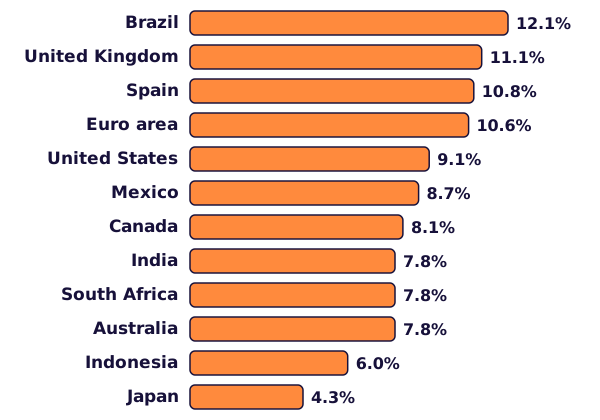
| Economy | Peak month | Peak inflation |
|---|---|---|
| Turkey | October 2022 | 85.5% |
| Brazil | April 2022 | 12.1% |
| United Kingdom | October 2022 | 11.1% |
| Spain | July 2022 | 10.8% |
| Euro area | October 2022 | 10.6% |
| United States | June 2022 | 9.1% |
| Mexico | September 2022 | 8.7% |
| Canada | June 2022 | 8.1% |
| India | April 2022 | 7.8% |
| South Africa | July 2022 | 7.8% |
| Australia | Fourth quarter 2022 | 7.8% |
| Indonesia | September 2022 | 6.0% |
| Japan | January 2023 | 4.3% |
Some countries went much further. Argentina's inflation passed 200% at the end of 2023 and peaked near 290% in April 2024, before falling sharply in 2025. Central banks answered with the fastest run of interest-rate rises in decades, and by 2024 inflation in most major economies had fallen back towards target. In 2025, euro area inflation was close to 2%, while US and UK inflation stayed above target.
What inflation does to your money
Here is what 100 in cash can buy after 10, 20 and 30 years at different inflation rates. The currency doesn't matter: the maths is the same everywhere.
| Inflation | After 10 years | After 20 years | After 30 years |
|---|---|---|---|
| 2% a year | 82 | 67 | 55 |
| 3% a year | 74 | 55 | 41 |
| 5% a year | 61 | 38 | 23 |
| 10% a year | 39 | 15 | 6 |
That is why savers look for returns above inflation. Your real return is roughly your return minus inflation. A deposit paying 4% while inflation is 3% grows your buying power by only about 1% a year. In 2022, a saver earning 1% while prices rose about 9% lost roughly 7% of their buying power in a single year.
Over long periods, growth assets such as shares have usually beaten inflation, with big ups and downs along the way. Some governments also sell inflation-linked bonds, such as US TIPS and UK index-linked gilts, whose payments rise with prices. Cash still has a job: an emergency fund should be safe and easy to reach.
How central banks fight inflation
When inflation runs hot, central banks raise interest rates. Loans and mortgages get more expensive, spending cools and prices rise more slowly. When the economy is weak and inflation is low, they cut rates to help.
The 2022 wave showed how far they will go. Between March 2022 and July 2023, the US Federal Reserve lifted its main rate from near zero to between 5.25% and 5.5%. Between December 2021 and August 2023, the Bank of England went from 0.1% to 5.25%. From July 2022 to September 2023, the ECB raised its deposit rate from minus 0.5% to 4%. As inflation fell, most of them began cutting rates in 2024.
Markets react to the surprise, not to the number itself. If inflation comes in above the forecast, traders expect higher interest rates for longer, so that country's currency often jumps and its share prices often fall. A miss of just 0.1 percentage point can move currencies and shares within seconds.
FAQ
What is inflation in simple terms?
Inflation is the rate at which prices rise across an economy. At 3% inflation, a basket of shopping that cost 100 a year ago costs 103 today, so each unit of money buys a little less.
How is inflation measured?
Statisticians track the prices of a typical household shopping basket every month. The basket price is the consumer price index (CPI), and its change over 12 months is the inflation rate in the news.
What is a healthy inflation rate?
The Fed, the ECB and the Bank of England all aim for 2% a year. Many emerging economies aim a little higher: Bank Indonesia targets 2.5%, Banxico 3% and the Reserve Bank of India 4%, each with a tolerance band.
What causes inflation?
Usually a mix: energy and food price shocks, supply problems, strong demand, a weaker currency and, in extreme cases, printing too much money. Expectations matter too. If everyone expects higher prices, inflation can feed itself.
Is deflation good for consumers?
Rarely. Prices falling across the whole economy usually mean weak demand, so companies cut jobs and people put off spending, which can deepen the slump.
How can I protect my savings from inflation?
Keep an emergency fund in cash, then look for returns above inflation over the long term, for example by spreading money across deposits, bonds and growth assets. This is general education, not personal advice.
Sources: National statistics offices (US Bureau of Labor Statistics, UK Office for National Statistics, Eurostat, INE Spain, BPS Indonesia, INEGI Mexico, India MoSPI, Statistics Canada, Statistics Bureau of Japan and others); central bank publications (Federal Reserve, ECB, Bank of England, Bank Indonesia, Banxico, Reserve Bank of India). Educational content, not financial advice.

Feel inflation for yourself
Fill the inflation basket, then see how fuel, rent and food move the number.
Play Basket CaseKeep reading
 How to choose a safe, regulated brokerHow to check a broker's licence with the FCA, ASIC, CySEC, SEBI, OJK or another regulator, which protections cover your money, and the red flags of scams.Read the guide
 Gold price history: yearly averages since 2000 and what moves goldGold averaged $279 an ounce in 2000 and $3,442 in 2025, then passed $5,000 in 2026. See every year, the 2024 to 2026 rally, and what moves the gold price.Read the guide
 ETFs and index funds for beginnersETFs and index funds explained: how they work, what a TER costs over 30 years, index vs active funds (SPIVA data), the main risks and how to start.Read the guide