Gold price history: yearly averages since 2000 and what moves gold
Gold averaged about $279 an ounce in 2000 and about $3,442 in 2025, more than 12 times higher, based on World Bank prices. It first passed $4,000 in October 2025, and its monthly average peaked at about $5,020 in February 2026 before easing to about $4,319 in September 2026. Below: every year, what drove the big moves, and what to know before you buy any.
Gold by year, 2000 to 2025
Yearly averages in US dollars per troy ounce (31.1 grams), the standard unit for precious metals worldwide.
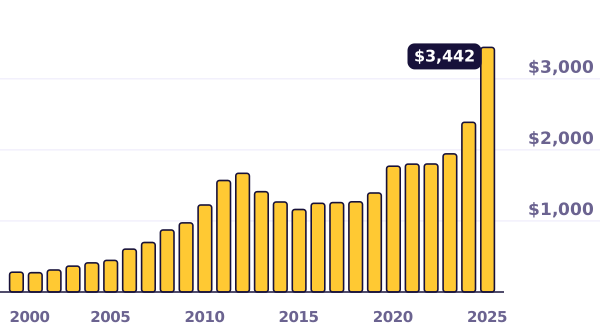
| Year | Average price | Change | What happened |
|---|---|---|---|
| 2000 | $279 | ||
| 2001 | $271 | −3% | |
| 2002 | $310 | +14% | |
| 2003 | $364 | +17% | |
| 2004 | $409 | +12% | |
| 2005 | $445 | +9% | |
| 2006 | $604 | +36% | |
| 2007 | $697 | +15% | |
| 2008 | $872 | +25% | Global financial crisis |
| 2009 | $973 | +12% | |
| 2010 | $1,225 | +26% | |
| 2011 | $1,569 | +28% | Euro debt crisis, fear of US debt |
| 2012 | $1,670 | +6% | Highest yearly average until 2020 |
| 2013 | $1,412 | −15% | Biggest yearly fall of the period |
| 2014 | $1,266 | −10% | |
| 2015 | $1,161 | −8% | Low point after the 2011 to 2012 peak |
| 2016 | $1,249 | +8% | |
| 2017 | $1,258 | +1% | |
| 2018 | $1,269 | +1% | |
| 2019 | $1,393 | +10% | |
| 2020 | $1,770 | +27% | Pandemic: new record |
| 2021 | $1,800 | +2% | |
| 2022 | $1,801 | +0% | High inflation, but rates rose fast |
| 2023 | $1,943 | +8% | |
| 2024 | $2,388 | +23% | Central banks keep buying, rate cuts begin |
| 2025 | $3,442 | +44% | Record year: first above $4,000 in October |
2026 is not over, so it is not in the table yet. From January to September 2026, the monthly averages came to about $4,550 an ounce, already well above the 2025 record.
The 2024 to 2026 gold rally
From late 2023, gold went on one of the strongest runs in its history. The yearly average rose about 23% in 2024 and about 44% in 2025. Gold first passed $3,000 an ounce in March 2025 and $4,000 in October 2025, then passed $5,000 in early 2026. Several forces pushed the same way:
- Central banks kept buying large amounts of gold for their reserves.
- Interest rates started to fall. The US Federal Reserve began cutting rates in September 2024. Gold pays no interest, so lower rates made it more attractive.
- The dollar weakened in 2025, which made gold cheaper for buyers paying in other currencies.
- Worry about wars, trade tariffs and government debt pushed investors towards safe havens, and money flowed into gold ETFs.
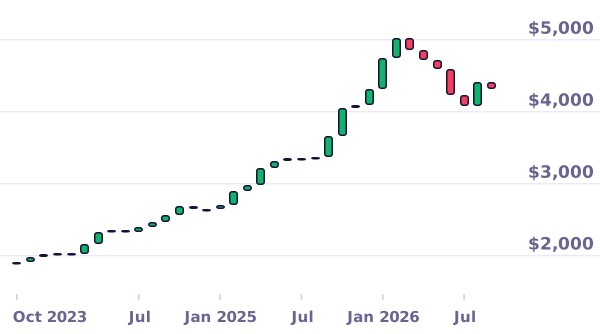
The rally did not go in a straight line. After the February 2026 peak, the monthly average fell to around $4,070 in July 2026. Someone who bought at the February average was still down about 14% in September.
Why gold rises in a crisis
No government can print gold, and gold can't go bankrupt. When people get scared of a crash, a war or a weak currency, money moves into it. That is why gold is called a safe haven. Its average price more than doubled from 2007 to 2011, the years of the global financial crisis and the euro debt crisis.
Central banks buy too. According to the World Gold Council, they added more than 1,000 tonnes a year to their reserves in 2022, 2023 and 2024, and kept buying in 2025, as many of them moved part of their reserves away from the US dollar.
Interest rates and the dollar
Gold pays no interest. When real interest rates (rates minus inflation) rise, savers can earn more elsewhere and gold tends to struggle. When real rates fall, gold looks better. That helps explain why gold's average barely moved in 2022 despite high inflation: interest rates were rising fast at the same time.
Gold is priced in US dollars, so a weaker dollar usually lifts its price. Outside the US there is a second effect. When your own currency weakens against the dollar, gold in your money rises even faster. That is why gold prices in rupees, rupiah or pesos can hit records even when the dollar price does not.

Ounces to grams: divide the price per troy ounce by 31.1. Gold at $4,300 an ounce is about $138 per gram.
Ways to own gold
- Bars and coins. Simple and physical, but you need a safe place to keep them, and dealers charge a premium over the market price.
- Gold ETFs. Funds that hold gold and trade on a stock exchange. Easy to buy and sell, with a small yearly fee, often 0.1% to 0.4%.
- Gold savings apps and "digital gold". Popular in India and Indonesia for buying small amounts by the gram. Check who stores the gold, what fees apply when you sell, and which regulator, if any, supervises the product.
- Gold mining shares. Companies that dig gold. They often move more than gold itself, in both directions, because mining costs stay fixed.
- Futures and CFDs. Contracts for trading the price, up or down, usually with leverage. With 20:1 leverage, a 5% move against you wipes out your whole margin. Holding them costs money every night, so they suit short trades, not long-term saving.
Risks to know
- Gold pays no interest and no dividend. All of the return comes from the price.
- It can fall for years. After peaking in 2011 and 2012, gold's yearly average fell about 30% to $1,161 in 2015, and only set a new record in 2020.
- It can swing hard even in a strong run: in 2026 the monthly average fell about 19% in five months, from February to July.
- Physical gold has a gap between the buying and selling price: on the same day, you pay more than you get back. That gap eats short-term gains, so gold works best as long-term savings.
FAQ
When did gold first pass $4,000 an ounce?
In October 2025. Its monthly average rose from about $3,670 in September 2025 to about $4,060 in October, and gold went on to pass $5,000 in early 2026.
What was the average gold price in 2025?
About $3,442 an ounce, based on World Bank data. That was a record, about 44% higher than the 2024 average of $2,388.
Why does gold often rise when stocks fall?
In a panic, investors look for assets that hold their value. Gold can't be printed and has no company behind it that can fail, so money often moves into it when shares drop. It doesn't happen every time: in the first days of a crash, people sometimes sell everything, gold included, to raise cash.
Is gold a good hedge against inflation?
Over long periods gold has protected buying power, but not reliably from year to year. In 2022, inflation was the highest in decades, yet gold's average price barely changed because interest rates were rising fast.
Why is gold priced in ounces?
Precious metals are traded worldwide in troy ounces. One troy ounce is 31.1 grams, a little heavier than the 28.35-gram ounce used for food.
How much gold should I own?
There is no single answer. Many investors who own gold keep it to a small part of their savings, to spread risk rather than as a bet. This is general education, not personal advice.
Sources: World Bank commodity price data (Pink Sheet gold prices: yearly averages to 2025, monthly averages to September 2026); World Gold Council (central bank purchases). Educational content, not financial advice.

Where does money run in a panic?
Pick the assets that rose in real crises, then see the move measured with real prices.
Play Safe Haven SprintKeep reading
 ETFs and index funds for beginnersETFs and index funds explained: how they work, what a TER costs over 30 years, index vs active funds (SPIVA data), the main risks and how to start.Read the guide
 How to choose a safe, regulated brokerHow to check a broker's licence with the FCA, ASIC, CySEC, SEBI, OJK or another regulator, which protections cover your money, and the red flags of scams.Read the guide
 What is inflation? How it is measured and what it does to your moneyInflation for beginners: how the CPI basket works, central bank targets, why prices jumped in 2022, real returns and what inflation does to savings.Read the guide